
Why the Air Inside Your Home May Be Making You Sick
An allergen reducing air filter is one of the most effective tools you can use to fight sneezing, congestion, and itchy eyes indoors. Here’s a quick summary of what you need to know:
- True HEPA filters capture 99.97% of airborne particles as small as 0.3 microns, including pollen, dust, pet dander, and mold spores
- Match your filter to your room size using CADR ratings for the best results
- Aim for at least 4.8 air changes per hour (ACH) — 6 ACH is ideal for severe allergies
- Avoid ionic cleaners and ozone generators — they don’t remove all particles and can irritate airways
- Replace filters regularly — every 3 months for HVAC filters, every 6–12 months for HEPA units
Here’s something that might surprise you: the air inside your home can actually be more polluted than the air outside. The U.S. Environmental Protection Agency ranks indoor air pollution among the top five environmental health risks — yet most of us spend around 90% of our time indoors.
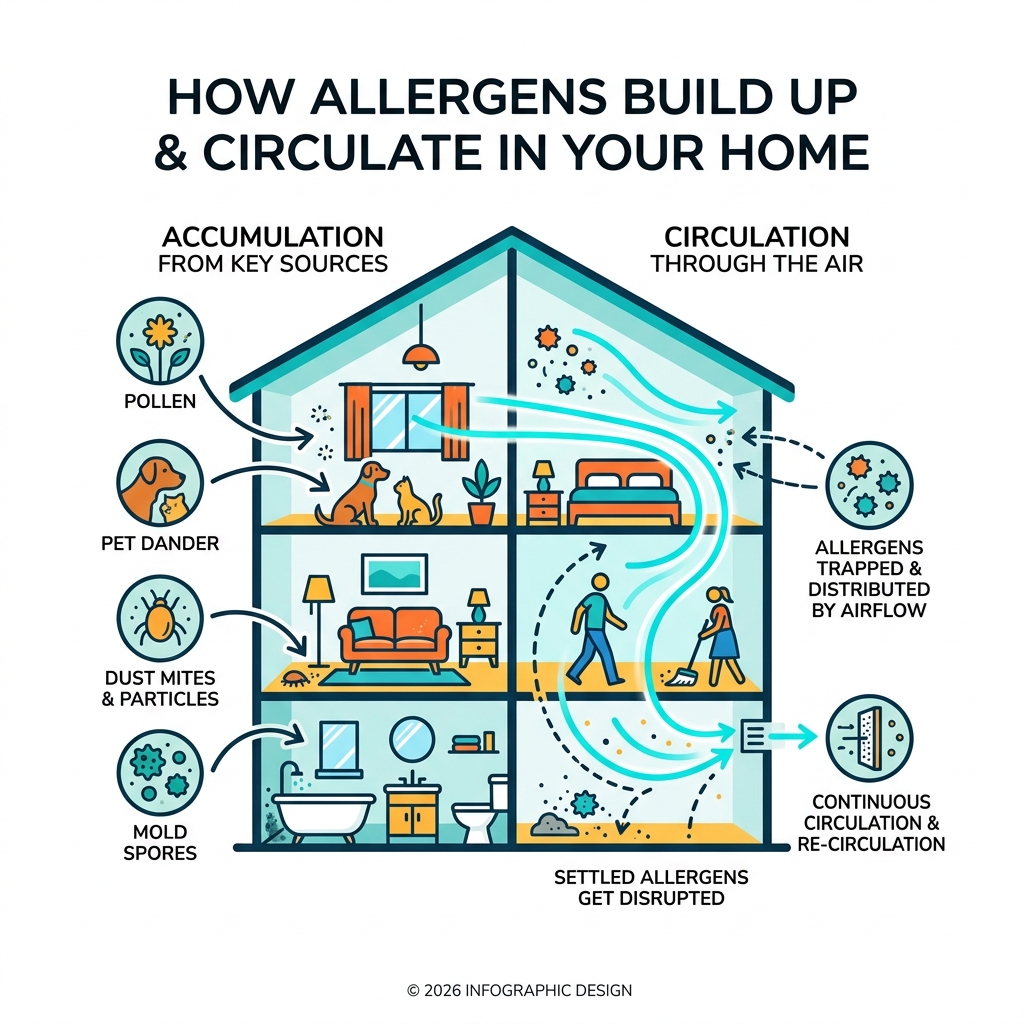
When your home’s air isn’t circulating well, common triggers build up fast. Dust mites settle into furniture. Pet dander floats through every room. Mold spores hide in corners. Pollen drifts in through open windows and sticks around long after you’ve closed them.
For allergy sufferers, this isn’t just uncomfortable — it can seriously disrupt sleep, focus, and daily life.
The good news? The right filtration system can make a real difference. And you don’t need to overhaul your whole home to feel it.
Understanding the Allergen Reducing Air Filter
When we talk about an allergen reducing air filter, we are usually referring to a high-efficiency medium designed to trap microscopic irritants. Most people are familiar with the standard filters found in a furnace, but for true allergy relief, we need to look closer at the technology inside the frame.
The “gold standard” in the industry is the True HEPA filter. HEPA stands for High-Efficiency Particulate Air. To earn this title, a filter must be able to remove at least 99.97% of dust, pollen, mold, bacteria, and any airborne particles with a size of 0.3 microns. To give you some perspective, a human hair is about 50 to 70 microns wide. We are talking about trapping particles that are 1,000 times smaller than what the naked eye can see!
Understanding these microscopic threats is the first step toward a clearer nose. If you want to dive deeper into why these particles are so persistent, check out our guides on the unseen challenge: dust and allergens in your apartment and dust and allergens in your apartment: what you need to know.
How an allergen reducing air filter works
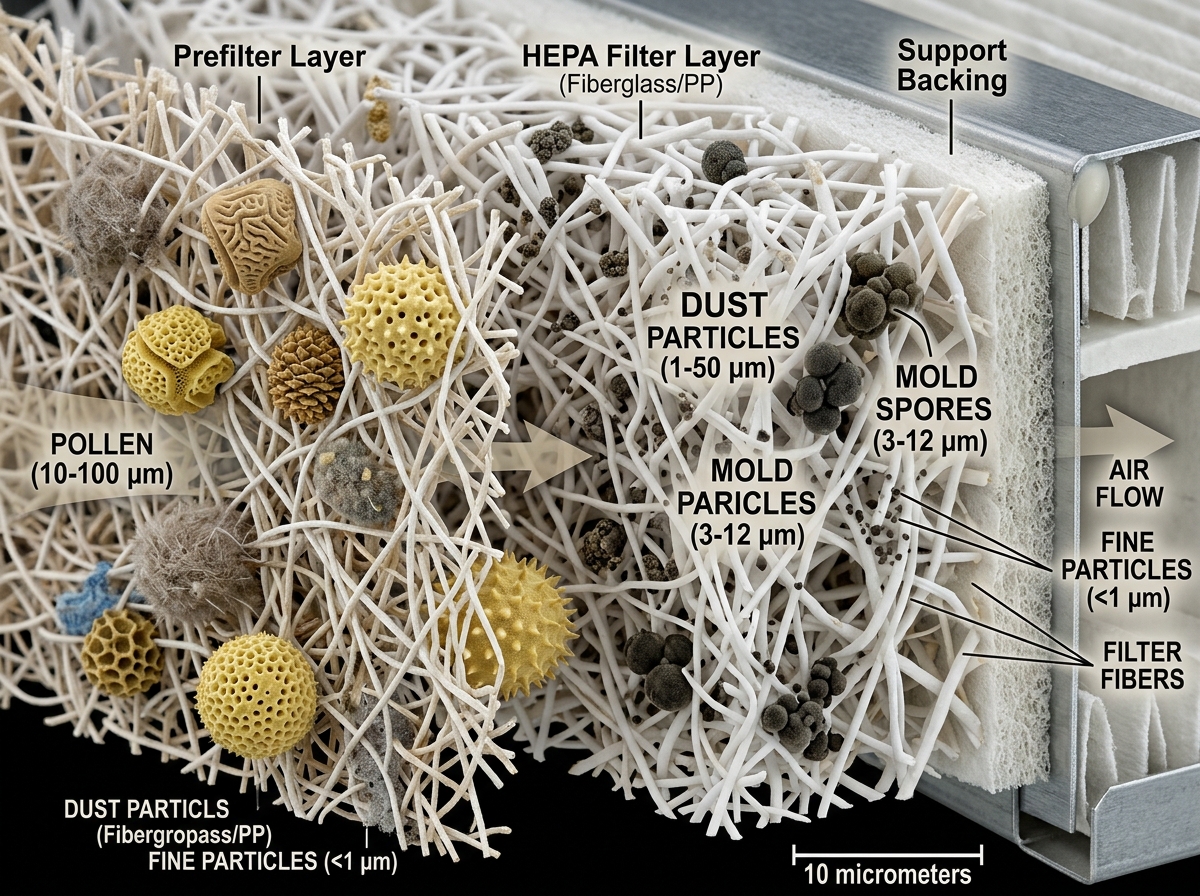
So, how does a piece of “paper” stop a microscopic piece of pollen? It’s actually a bit of a mechanical miracle. An allergen reducing air filter doesn’t just act like a kitchen sieve where big things get stuck. Instead, it uses three main methods:
- Interception: Particles following the line of air come within one radius of a fiber and stick to it.
- Impaction: Larger particles are too heavy to follow the curving air currents around the fibers and instead “crash” directly into them.
- Diffusion: The smallest particles move erratically (Brownian motion) and eventually bump into a fiber and get stuck.
Many modern filters also use an electrostatic charge. Think of this like a magnet for dust. By charging the filter fibers, the filter can “pull” particles out of the air even if they aren’t headed directly for a collision. This allows for high efficiency without completely blocking the airflow.
Choosing the right allergen reducing air filter for your space
Choosing a filter isn’t a “one size fits all” situation. We generally look at two main paths: portable room units and whole-house HVAC integration.
Portable units are fantastic for bedrooms or home offices where you spend most of your time. They allow for localized, intense cleaning. On the other hand, upgrading your central furnace filter can help maintain a baseline of cleanliness throughout the entire house. However, be careful! If you put a filter that is too thick in your furnace, it can restrict airflow and damage your motor. We’ve covered this in detail in our article don’t let your furnace choke on your allergies.
Key Performance Metrics for Allergy Relief
If you’ve ever shopped for an air purifier, you’ve probably seen a wall of acronyms like CADR, ACH, and MERV. Don’t let them intimidate you! These are just tools to help us measure how much “work” a filter can do.
CADR (Clean Air Delivery Rate) is perhaps the most important metric for portable units. It measures how quickly a purifier removes specific pollutants like smoke, dust, and pollen. A higher number means faster cleaning. As a rule of thumb, your CADR should be at least two-thirds of your room’s square footage.
ACH (Air Changes Per Hour) tells us how many times the machine can cycle all the air in a room through the filter in 60 minutes. For general health, 2 or 3 ACH might be fine. But for us allergy sufferers, the Association of Home Appliance Manufacturers (AHAM) recommends at least 4.8 ACH. If your allergies are severe, we suggest aiming for 6 ACH—which means your air is being scrubbed clean every 10 minutes.
Noise levels and sleep quality
Since most of us need our air purifiers to run while we sleep (when congestion often peaks), noise is a huge factor. A machine that cleans the air perfectly but sounds like a jet engine isn’t going to help you feel rested.
Look for units that operate sub-45 dBA on their “sleep” or “low” settings. For context, 30 dBA is like a whisper, while 50 dBA is a normal conversation. Many high-quality units, like the compact-air-purifiers-that-tackle-allergies, are designed specifically to be whisper-quiet for nighttime use.
Top-Rated Filtration Technologies for Your Home
Not all filters are created equal. When browsing for an allergen reducing air filter, you’ll likely encounter several different “grades” of technology.
- MERV 13: This is the highest rating typically recommended for residential HVAC systems. It is excellent at catching bacteria, smoke, and microscopic allergens without putting too much strain on your furnace fan.
- True HEPA vs. HEPA-type: Always look for “True HEPA.” “HEPA-type” or “HEPA-like” filters are not held to the same 99.97% standard and may let smaller allergens slip through.
- Activated Carbon: This doesn’t catch particles like dust, but it is essential for removing odors and VOCs (Volatile Organic Compounds). If you have “chemical” allergies or are sensitive to smoke and cooking smells, a carbon layer is a must.
- AllergenBlock and Nanoseal: Some premium filters, such as the Anti-Allergen True HEPA NANOSEAL™ Filter with Odour Lock, use specialized coatings to neutralize allergens or extra-fine mesh to catch particles as small as 0.1 microns.
Particle vs gas filtration
It’s important to distinguish between what we want to stop. If your main enemies are pollen, pet dander, and mold spores, you need a high-quality particle filter (HEPA). If you are trying to stop smoke or chemical fumes, you need gas filtration (Activated Carbon).
Many of the best options on the market, such as the Filtrete™ Premium Allergen & Ultrafine Particles + Odor Reduction Room Air Purifier Filter FAPF-D-4, D | 3M United States , combine both into one convenient unit. This gives you a “one-two punch” against both the things that make you sneeze and the things that make your house smell like last night’s dinner.
Maintenance and Best Practices for Clean Air
Buying an allergen reducing air filter is only half the battle; you have to keep it in fighting shape. A clogged filter is worse than no filter at all because it forces your machine to work harder while cleaning less air.
Here is our recommended maintenance schedule:
- HVAC Filters (MERV 11-13): Replace every 3 months. If you have pets or live in a high-pollen area, check them every 2 months.
- HEPA Filters: These usually last 6 to 12 months. Some high-end models can go longer, but 12 months is a safe limit for most households.
- Pre-filters: If your unit has a washable foam or mesh pre-filter, clean it every 2 to 4 weeks. This keeps the “big” stuff like hair and lint from clogging your expensive HEPA filter.
For more detailed timing, see our guide on the air-filter-replacement-schedule.
Avoiding ineffective technologies
We want to save you some money and potential lung irritation by warning you about a few “fancy” technologies that don’t always live up to the hype:
- Ionic Cleaners: These work by sending out charged ions to make particles stick to surfaces. The problem? Those particles often just stick to your walls or floor instead of being removed from the air. Worse, many ionizers produce ozone, which is a known lung irritant and can actually trigger asthma attacks.
- UVGI (Ultraviolet Germicidal Irradiation): While UV light can kill bacteria, it only works if the air stays under the light for a long time. In a fast-moving air purifier, the “kill rate” is often very low.
- PCO (Photocatalytic Oxidation): This is great for some gases, but if not designed perfectly, it can produce harmful byproducts like formaldehyde. Stick to HEPA and Carbon for the safest results.
Beyond Filtration: A Holistic Approach to Allergy Management
While a great allergen reducing air filter is your secret weapon, it shouldn’t be your only one. We believe in a “defense in depth” strategy.
First, control the humidity. Dust mites and mold thrive in damp air. Keep your home’s humidity between 30% and 50%. Any higher and you’re inviting mold to grow; any lower and your nasal passages will dry out and become more sensitive.
Second, think about your surfaces. Air purifiers catch what’s in the air, but they can’t grab the dust sitting in your carpet. Regular cleaning is essential. We recommend:
- Vacuuming for allergen reduction using a machine with a HEPA exhaust.
- Cleaning carpets to reduce allergens at least once a year.
- Using dusting tips for better air quality, like using damp cloths instead of feather dusters that just kick dust back into the air.
Finally, don’t forget the pets! Grooming your furry friends outside can prevent a massive amount of dander from ever entering your living room.
Frequently Asked Questions about Air Filtration
Are washable filters effective for severe allergies?
Generally, no. While “permanent” or washable filters are eco-friendly and save money, they are almost impossible to clean perfectly. Microscopic allergens get trapped deep in the fibers, and washing them can sometimes lead to mold growth if they don’t dry quickly. For severe allergies, disposable True HEPA filters are much more effective.
How do I know if my filter needs replacing?
Most modern units have indicator lights, but you shouldn’t rely on them alone. If you notice a “musty” smell, see visible dust buildup on the outer mesh, or feel that the airflow coming out of the machine is weaker than usual, it’s time for a change. High-quality replacements like the Filtrete™ Allergen Reduction + Odor Reduction HEPA-Type Room Air Purifier Filter FAPF-F1-O, F1 | 3M United States ensure you stay protected.
Can one air purifier cover my whole house?
Rarely. Even a very powerful unit with a high CADR will struggle to pull air from behind closed doors or down long hallways. Air purifiers work best when they have a clear “line of sight” to the air in the room. We usually recommend placing one unit in the bedroom and another in the main living area rather than trying to use one massive machine for everything.
Conclusion
At Computadora Agora, we know that breathing easy shouldn’t be a luxury. Investing in a high-quality allergen reducing air filter is an investment in your sleep, your health, and your comfort. By combining a True HEPA filter with smart maintenance and good cleaning habits, you can transform your home from an allergy minefield into a safe haven.
Ready to take control of your indoor air? Explore our full range of air purifiers and find the perfect match for your home today. Stop sneezing and start breathing!
