
Your Indoor Air May Be Making You Sick
The best air purifier for allergies uses a True HEPA filter to capture at least 99.97% of airborne particles — including pollen, dust, and pet dander — and is sized correctly for your room using CADR and ACH ratings.
Quick picks by room size:
| Room Size | What You Need | Key Spec |
|---|---|---|
| Small (under 200 sq ft) | Compact HEPA purifier | CADR 100-150 cfm |
| Medium (200-600 sq ft) | Mid-range HEPA purifier | CADR 150-400 cfm |
| Large (600+ sq ft) | High-capacity HEPA purifier | CADR 400+ cfm |
| Whole home | MERV 13 HVAC filter | Replace every 3 months |
Here’s something that might surprise you: the air inside your home can be two to five times more polluted than the air outside, according to the U.S. Environmental Protection Agency. And since most of us spend up to 90% of our time indoors, that’s a lot of exposure to dust, pollen, pet dander, and other allergens floating around in the air we breathe every day.
For allergy sufferers, that means constant sneezing, congestion, itchy eyes — often without knowing why.
The good news? A well-chosen air purifier can make a real difference. But not all purifiers work the same way. Some are too weak for your room. Some use technology that can actually irritate your airways. And many overstate what they can do.
This guide cuts through the noise so you can find the right purifier for your home, your room size, and your budget.
What Makes an air purifier for allergies Effective?
When we talk about an effective air purifier for allergies, we are really talking about two things: the quality of the filter and the volume of air it can move. Indoor air pollution is ranked as one of the top five environmental health risks by the EPA, largely because we spend so much time in sealed environments where dust and dander accumulate.
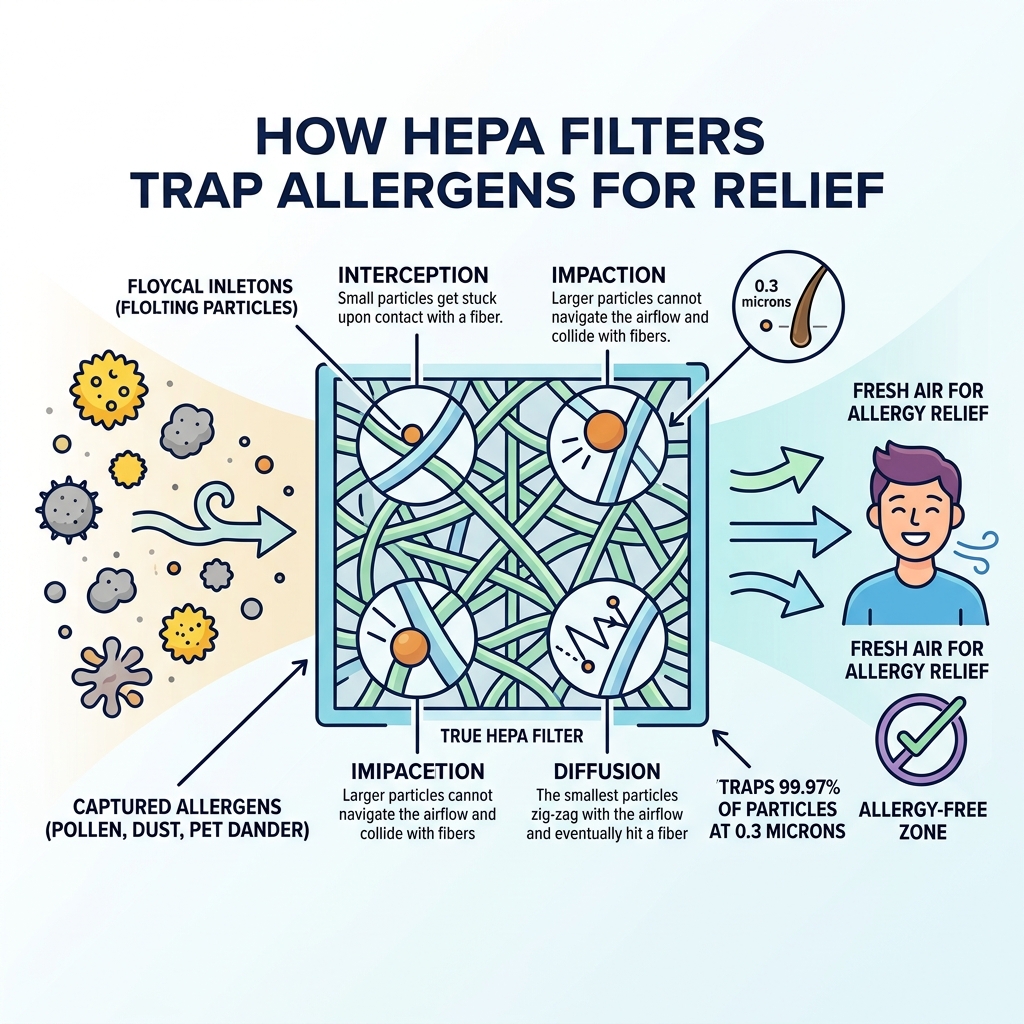
The “gold standard” for allergy relief is HEPA (High-Efficiency Particulate Air) filtration. A True HEPA filter is certified to remove 99.97% of dust, pollen, and airborne particles as small as 0.3 microns. To put that in perspective, a human hair is about 50 to 70 microns wide. We’re talking about trapping particles you can’t even see but your immune system definitely feels.
However, a great filter is useless if the machine can’t pull enough air through it. This is where CADR (Clean Air Delivery Rate) comes in. CADR measures how quickly a unit removes smoke, dust, and pollen from the air. For instance, the Blue Pure 211i Max Air Purifier | Large Room HEPA Filter | Blueair boasts high CADR ratings (over 400 cfm for pollen and dust), meaning it can cycle the air in a large room multiple times per hour.
It is also important to distinguish between particle and gas filtration. Most allergy sufferers react to particles (pollen, pet dander, mold spores). While some units, like the Coway Airmega 250 – Large Room Air Purifier for Mold, Pollen & Viruses – Cowaymega, include activated carbon filters to handle odors and chemicals, the HEPA component is what does the heavy lifting for your sneezing fits. Understanding the unseen challenge: dust and allergens in your apartment is the first step toward choosing a machine that actually clears the air rather than just moving it around.
Best air purifier for allergies in Large Living Spaces
If you have an open-concept living area or a large master suite, a small “desktop” purifier won’t cut it. For these spaces, we recommend heavy hitters like the Coway Airmega 450 | Home & Office Air Purifier | Extra Large Spaces Purifier – Cowaymega.
This unit is a beast, capable of covering up to 3,285 square feet in just one hour. It utilizes “HyperVortex” technology—an engineered airflow system that uses an eagle vane design and vortex generator to maximize air intake while keeping noise levels manageable. It also features smart sensors that monitor air quality in real-time, adjusting the fan speed automatically when it detects a spike in pollutants.
For those with severe respiratory sensitivities, the Atem X | IQAir represents the premium end of the spectrum. It uses HyperHEPA filtration, which is tested to capture 99.5% of particles down to an incredible 0.003 microns. That is 100 times smaller than what a standard HEPA filter catches, making it effective against the tiniest viruses and ultra-fine smoke particles.
Best Compact air purifier for allergies in Bedrooms
Bedrooms require a different strategy. You need high performance, but you also need to sleep. A unit that sounds like a jet engine taking off won’t help your health if it keeps you awake all night.
The Blue Pure 311i+ Max | Smart Air Purifier for 465 ft² Spaces | Blueair is an excellent choice for medium-sized bedrooms. It uses HEPASilent technology, which combines electrostatic charging with mechanical filtration. This allows the fan to push air through a less dense filter, resulting in a whisper-quiet operation as low as 23 dB—quieter than a soft rustle of leaves.
When looking for compact air purifiers that tackle allergies, focus on models that offer a dedicated “Sleep Mode.” These top-rated compact air purifiers often include light-dimming features so the display won’t glow in your face while you’re trying to rest.
Key Specifications to Compare Before Buying
Buying an air purifier for allergies can feel like learning a new language. To make it easier, we’ve broken down the most important specs you’ll see on the box.

Air Changes Per Hour (ACH)
This is perhaps the most critical metric for allergy sufferers. While a manufacturer might say a unit “covers 1,000 square feet,” they often base that on only one air change per hour. For true allergy relief, the Association of Home Appliance Manufacturers (AHAM) recommends at least 4.8 ACH. If your allergies are severe, you should aim for 6 ACH, which means the machine cleans all the air in the room every 10 minutes.
CADR and Room Size
Always match the CADR to your room size. A common mistake is buying a budget unit for a large room. For example, the Blue Pure 511 Bundle | Small Room Air Purification System | Blueair is perfect for a nursery or home office (around 189 sq. ft.), but it would struggle in a large living room. You can find more details in our HEPA air purifiers for small spaces: a detailed review or check out our list of top air purifiers for small rooms on a budget.
Energy Star Certification
Since you’ll likely run your purifier 24/7 during allergy season, look for the Energy Star label. These models are typically 40% more energy-efficient than standard units, meaning they won’t cause your electric bill to skyrocket.
Maintenance and Complementary Allergy Control
An air purifier is a tool, not a magic wand. To keep it working effectively, you must stay on top of maintenance. Most HEPA filters need replacement every 6 to 12 months, depending on your air quality. Some modern units use “RealTrack” technology, which monitors actual pollutant levels and fan speed to tell you exactly when the filter is spent, rather than just relying on a generic timer.
Beyond the machine itself, we recommend a “whole-home” approach to allergen reduction:
- HVAC Filters: If you have central air, use a disposable MERV 11-13 filter. These catch pollen and mold without straining your system’s motor. Replace them every 3 months.
- Vacuuming: Even the best purifier only catches floating particles. Use a vacuum with a HEPA filter to handle the “settled” allergens in your carpet. See our guide on vacuuming for allergen reduction for more tips.
- Dusting: Use damp cloths rather than feather dusters, which just kick dust back into the air. Check out our dusting tips for better air quality.
- Carpet Care: Carpets are giant magnets for dander. Regular cleaning of carpets to reduce allergens can significantly lower your symptoms.
- Humidity Control: Keep your home’s humidity between 30% and 50%. Anything higher encourages mold growth and dust mite activity.
Frequently Asked Questions about Allergy Air Purifiers
Should I avoid ionizers or ozone generators?
Yes, generally speaking. Many experts and organizations like the EPA warn against ozone generators because ozone is a lung irritant that can actually worsen asthma and allergy symptoms. While some ionizers are safe, they often produce trace amounts of ozone as a byproduct. For allergy sufferers, stick to mechanical filtration (HEPA and carbon). It’s proven, safe, and doesn’t add chemicals to your air.
How often should I replace my HEPA filter?
Most manufacturers recommend every 6 to 12 months, but if you live in a high-pollen area or have multiple pets, you might need to swap it sooner. A “check filter” indicator is a helpful feature, but you can also do a visual check. If the filter looks dark grey or caked with dust, it’s time for a new one. Ignoring this not only reduces air cleaning but can also damage the purifier’s motor. For more on this, read about dust and allergens in your apartment: what you need to know.
Can a budget air purifier under $200 really help?
Absolutely—provided you use it in the right size room. There are many affordable and efficient air purifiers for small rooms that perform exceptionally well. Models like the Levoit Core series often fall under this price point and are great for bedrooms. The key is to avoid “cheap” machines that use “HEPA-like” filters instead of True HEPA. Check out our list of budget-friendly air purifiers for your home for tested options that won’t break the bank.
Conclusion
At Computadora Agora, we know that breathing clean air isn’t just a luxury—for allergy sufferers, it’s a necessity for a good night’s sleep and a productive day. Whether you need the massive power of an Airmega 450 for your living room or a quiet Blueair for your nightstand, the right air purifier for allergies is out there.
Remember to prioritize HEPA filtration, check the CADR for your specific room size, and maintain your filters regularly. By combining a high-performance purifier with smart cleaning habits like HEPA vacuuming and proper HVAC maintenance, you can finally stop sneezing and start enjoying your home again.
Ready to clear the air? Explore more air quality solutions or browse our full category of air purifiers to find your perfect match.
