
Your Air Ducts Might Be Making You Sick — Here’s What to Do
DIY air duct mold removal is something most homeowners can handle for small, accessible mold patches — but it requires the right gear, the right cleaners, and knowing when to stop.
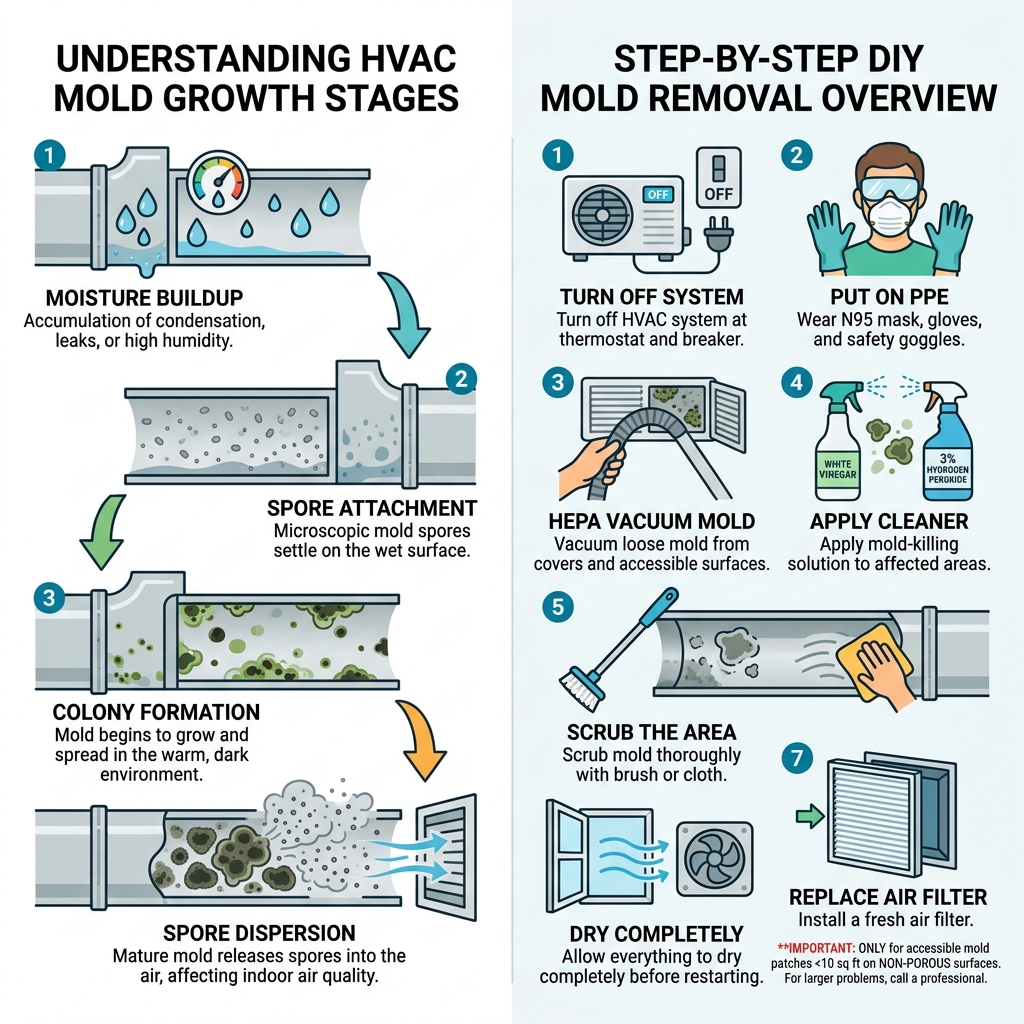
Quick answer — how to remove mold from air ducts yourself:
- Turn off your HVAC system at the thermostat and breaker before you start
- Put on protective gear — N95 mask, rubber gloves, and safety goggles
- Vacuum loose mold from vent covers and accessible duct surfaces using a HEPA vacuum
- Apply a mold-killing solution — undiluted white vinegar, 3% hydrogen peroxide, or a diluted bleach mix (1 part bleach to 16 parts water)
- Scrub the area with a long-handled brush or microfiber cloth
- Dry everything completely before turning the system back on
- Replace your air filter and monitor for regrowth over the next few weeks
Important: DIY is only appropriate for mold patches smaller than 10 square feet on non-porous surfaces like metal duct registers. Anything larger, deeper, or on porous materials like fiberglass duct board needs a professional.
That musty smell when your AC kicks on isn’t just unpleasant. It’s a warning sign.
Mold growing inside your air ducts gets distributed through every room in your home every time your HVAC system runs. That means your family is breathing in mold spores all day — and for people with allergies, asthma, or sensitivities, that can cause real health problems.
The good news? If the mold is caught early and stays in an accessible area, you can tackle it yourself over a weekend. This guide walks you through exactly how to do it safely.
Identifying the Signs and Causes of HVAC Mold
Before you grab your scrub brush, we need to make sure you’re actually dealing with mold. HVAC systems are dark and sometimes damp, making them the perfect “Airbnb” for fungi, bacteria, and even algae.
Common Signs of a Problem
The most obvious sign is a persistent musty or mildew-like odor that gets stronger when the air conditioner or heater is running. You might also notice visible dark streaks, fuzzy green or black spots, or slimy patches around your vent covers (registers).
Physically, your body might react before your eyes do. If you find yourself sneezing, coughing, or dealing with itchy eyes and headaches only when you’re at home, your ducts might be the culprit. Understanding the threat of mold in your home is the first step in protecting your family’s health.

Why is it Growing There?
Mold isn’t magic; it needs three things to thrive: moisture, a food source, and the right temperature.
- High Humidity: Keeping indoor humidity levels above 60% is like laying out a red carpet for mold. Ideally, we want to keep our homes between 30% and 50% humidity.
- Condensation: When warm air hits cold metal ducts, water droplets form. If your ducts aren’t insulated properly, this “sweat” provides the drink mold needs.
- Dust and Debris: Mold doesn’t actually eat the metal of your ducts. It eats the skin cells, pet dander, and dust that settle inside them.
- Water Leaks: Roof leaks or plumbing issues that drip onto ductwork can create localized mold “hotspots.”
Mold vs. Dust Ghosting
Sometimes, what looks like mold is actually “ghosting.” This happens when soot or dust particles are attracted to cold spots on walls or vents via static electricity.
| Feature | True Mold | Dust Ghosting (Soot) |
|---|---|---|
| Texture | Fuzzy, slimy, or velvety | Dry and powdery |
| Pattern | Irregular, spreading “colonies” | Uniform streaks or outlines |
| Smear Test | Smears when wiped | Smudges like charcoal |
| Odour | Strong, earthy, musty | Usually odorless |
Is DIY Air Duct Mold Removal Safe and Effective?
Is diy air duct mold removal actually a good idea? The answer is: sometimes.
According to EPA guidelines, homeowners can generally handle mold remediation if the affected area is less than 10 square feet (roughly a 3-foot by 3-foot patch). If the mold is restricted to your removable vent covers or the first foot or two of metal ductwork, you can likely clean it effectively.
The Safety Risks
However, we have to talk about the dangers. When you scrub mold, you disturb it. This releases millions of microscopic spores and mycotoxins into the air. If you don’t have the right protective gear, you’ll breathe these in, leading to respiratory distress or even neurological impacts in sensitive individuals.
The Cross-Contamination Trap
The biggest risk of DIY efforts is spreading the problem. If you use a standard household vacuum without a HEPA filter, you are essentially picking up mold spores and “spraying” them out the vacuum’s exhaust into the rest of your house. This turns a small duct problem into a whole-house disaster.
Furthermore, DIY is only effective on non-porous surfaces like sheet metal or plastic. If you have fiberglass duct board or flexible ducts (which have a plastic ribbing over insulation), the mold roots itself deep inside the material. You cannot scrub it out; in those cases, the material usually needs to be replaced by a pro.
The Step-by-Step Guide to Cleaning Your System
If you’ve determined the mold is localized and on metal surfaces, it’s time to get to work. Following effective techniques for mold removal ensures you don’t just move the mold around.
1. Power Down
Safety first! Turn off your HVAC system at the thermostat. To be extra safe, flip the breaker in your electrical panel. You don’t want the fan kicking on while you’re elbow-deep in the vents, which would suck spores right into your face.
2. Gear Up
Don’t skimp here. You need:
- An N95 or P100 respirator mask.
- Safety goggles (the kind that seal against your face).
- Long rubber gloves.
- Disposable coveralls (optional but recommended).
3. Seal and Contain
Close the doors to the room you’re working in. If possible, tape plastic sheeting over the supply and return vents in other rooms to prevent any disturbed spores from traveling through the system.
4. Remove and Sanitize Vent Covers
Unscrew your registers (vent covers). Take them outside or to a bathtub. Scrub them thoroughly with a mold-killing solution. If they are metal, you can even run them through a dishwasher on a sanitize cycle.
5. HEPA Vacuuming
Use a vacuum equipped with a HEPA filter. Use the hose attachment to reach as far into the duct as possible. This removes the “biomass”—the physical clumps of mold and dust.
6. Scrub the Interior
Apply your cleaning solution (see the “Natural Solutions” section below) to a microfiber rag or a long-handled brush. Scrub the metal surfaces of the duct interior. Let the solution sit for at least 10–15 minutes to ensure it kills the mold at the root.
7. The Air Handler Cabinet
Check the air handler (the big box usually in your attic, basement, or closet). Check the evaporator coils and the drain pan. If you see standing water or slime, clean it carefully. Be extremely careful around electrical wiring; always ensure the power is off and use a damp—not dripping—cloth.
8. Dry Procedures
This is the most important step! Mold loves moisture. Use a hair dryer (on cool), a fan, or a dehumidifier to ensure the ducts are bone-dry before you put the vent covers back on and restart the system.
Essential Tools for DIY Air Duct Mold Removal
To do this right, you need more than a bucket of soapy water.
- N95 Respirator: Essential for filtering out spores.
- Safety Goggles: Protects your eyes from irritation.
- Rubber Gloves: Keeps chemicals and mold off your skin.
- HEPA Vacuum: Standard vacuums will spread spores; HEPA traps 99.97% of them.
- Long-handled Brushes: For reaching deep into the “boot” of the duct.
- Microfiber Rags: These trap particles better than paper towels.
Natural Solutions for DIY Air Duct Mold Removal
You don’t always need harsh chemicals. In fact, some pros prefer natural options for indoor air quality.
- White Vinegar: Undiluted white vinegar contains acetic acid, which kills about 82% of mold species. Spray it on, let it sit for an hour, and wipe.
- Hydrogen Peroxide (3%): This is a great antifungal and antibacterial. It “fizzes” as it works. Let it sit for 10 minutes before scrubbing.
- Baking Soda Paste: Mix baking soda with a little water. It’s a mild abrasive that kills mold and absorbs the musty odors. This is also a great tip for removing mold from bathroom surfaces.
- Tea Tree Oil: A natural fungicide. Mix 1 teaspoon with 1 cup of water. It’s expensive but very effective and leaves a fresh scent.
- Borax Solution: Mix 1 cup of borax with a gallon of water. It’s a natural mineral that prevents future mold growth.
When to Call a Professional for Remediation
We love a brave homeowner, but sometimes bravery turns into a health hazard. You should stop your DIY efforts and call a certified professional if:
- The Area is Huge: If mold covers more than 10 square feet of your system.
- Fiberglass is Involved: If you have fiberglass duct board or insulated “flex” ducts that are moldy, they cannot be cleaned; they must be cut out and replaced.
- The Mold Keeps Coming Back: This means you haven’t found the moisture source. A pro has moisture meters and infrared cameras to find hidden leaks.
- Inaccessible Areas: If the mold is deep in the main trunk lines where you can’t reach.
- Toxic Black Mold: If you suspect Stachybotrys chartarum (toxic black mold), which often looks slimy and dark greenish-black.
- Electrical Components: If mold is growing on the circuit boards or internal wiring of your furnace or AC unit, DIY cleaning can cause a short circuit or fire.
Professional remediation typically costs between $400 and $1,500, but it includes negative-pressure machines that ensure no spores escape into your living space.
Long-Term Prevention and Maintenance Strategies
Once you’ve finished your diy air duct mold removal, you never want to do it again. Prevention is much cheaper than remediation.
Control the Humidity
This is the “Golden Rule.” Use a dehumidifier to keep your home’s relative humidity below 50%. You can buy a cheap digital hygrometer to monitor this. Also, ensure your clothes dryer and bathroom fans vent outdoors, not into your attic or crawlspace.
Upgrade Your Filtration
Standard fiberglass filters (the cheap $2 ones) only stop “boulders.” To stop mold spores, you need a pleated filter with a MERV-13 rating. These are dense enough to trap microscopic spores before they enter your ductwork. Knowing how often to clean ac vents and change filters is vital; we recommend checking them monthly and replacing them every 1–3 months.
UV-C Light Installation
Many homeowners are now installing UV-C lights inside their air handlers. These lights stay on 24/7 and kill mold spores and bacteria as the air passes by. It’s like a continuous “sanitizer” for your air.
Regular Inspections
Schedule an annual HVAC tune-up. A technician will clean your evaporator coils and ensure your drain pan is tilting correctly so water doesn’t pool. For more ideas, check out our home ventilation cleaning tips.
Frequently Asked Questions about Duct Mold
Can I spray bleach in my air ducts?
We generally recommend against using bleach inside ductwork. Bleach is mostly water; on porous surfaces, the water soaks in while the chlorine stays on top, which can actually encourage mold growth later. Plus, bleach fumes are harsh and can corrode metal ducts over time. Stick to vinegar or EPA-approved HVAC disinfectants.
How often should I change my air filters to prevent mold?
In most homes, every 3 months is sufficient. However, if you have pets, live in a humid climate, or have recently done a diy air duct mold removal, you should check them every 30 days. If the filter looks gray or is starting to “bow” (bend), replace it immediately.
Will a UV light kill mold already in my ducts?
No. UV lights are a preventative measure. They kill spores floating in the air, but they won’t penetrate a thick colony of mold already growing on the duct walls. You must physically remove the mold first, then use the UV light to keep it from coming back.
Conclusion
Taking charge of your home’s air quality is a powerful move. By tackling diy air duct mold removal for minor issues, you’re improving your system’s efficiency and creating a much healthier environment for your family. The key is to stay safe, use the right HEPA-filtered equipment, and address the moisture source so the mold doesn’t return.
At Computadora Agora, we believe a proactive homeowner is a happy homeowner. Keep your system dry, your filters fresh, and your humidity low, and you’ll breathe easy for years to come. For more expert advice on keeping your living space pristine, check out our More info about cleaning services section!
