
What Dirty Air Vents Are Doing to Your Home Right Now
Dirty air vents are one of the most overlooked problems in any home — but they can quietly affect your health, your comfort, and your energy bills every single day.
Quick answer: Here’s what to check for right now:
| Warning Sign | What It Means |
|---|---|
| Dust buildup on vent grills | Air is pushing debris through your ducts |
| Musty or stale smell from vents | Possible mold or bacterial growth |
| Black streaks around vent covers | Soot, mold, or heavy dust accumulation |
| Worsening allergies indoors | Allergens recirculating through your HVAC |
| Uneven heating or cooling | Airflow is being restricted by buildup |
| Higher energy bills | Your HVAC is working harder than it should |
| Visible dust clouds when air kicks on | Significant debris loose inside your ducts |
If any of those sound familiar, you’re in the right place.
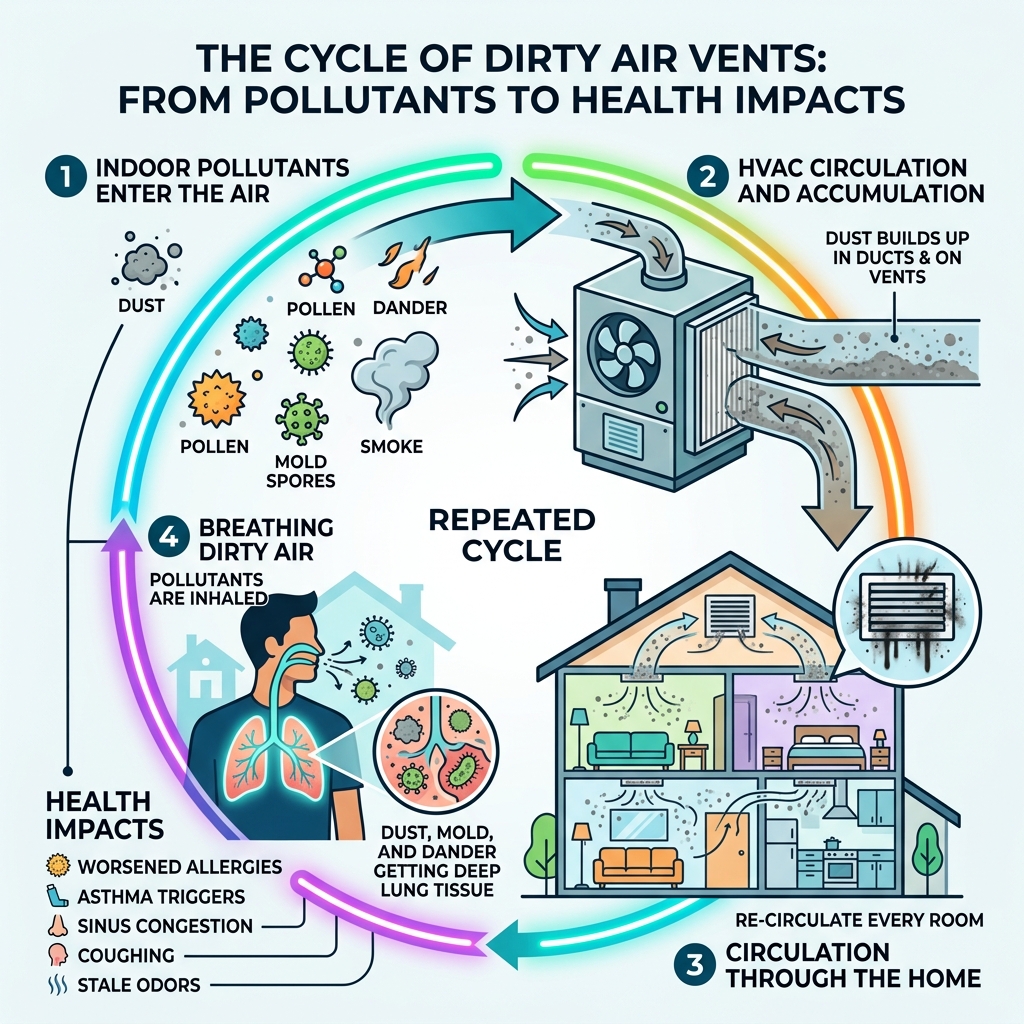
Here’s something that might surprise you: indoor air can be two to five times more polluted than the air outside. Your HVAC system circulates that air through your home repeatedly — and if your vents and ducts are dirty, every cycle spreads dust, pollen, pet dander, and potentially mold spores through every room.
Most homeowners don’t think about their air ducts until something goes obviously wrong. But the signs are usually there long before that.
This guide walks you through exactly how to spot the problem, what’s causing it, and what to do about it.
7 Warning Signs of Dirty Air Vents
Identifying dirty air vents doesn’t always require a flashlight and a ladder, though those certainly help. Often, your house is already trying to tell you that something is wrong. Because our HVAC systems are “out of sight, out of mind,” we tend to ignore the subtle cues until they become glaring issues.

Beyond the obvious dust, keep an eye out for these specific red flags:
- Dusty Grills: If you find yourself dusting your vent covers every week, the problem isn’t your cleaning routine—it’s what’s behind the vent.
- Black Buildup: Dark streaks or “ghosting” around the edges of ceiling vents.
- Musty Odors: A smell like wet socks or a damp basement whenever the AC kicks on.
- Rodent Evidence: Droppings that look like chocolate sprinkles (yuck!) or scratching sounds in the walls.
- Insect Debris: Finding wings or husks near your registers.
- Pet Dander Overload: If you have shedding pets, their fur inevitably finds its way into the return air.
- Spiking Allergies: If you feel better at work than you do at home, your ducts might be the culprit.
Visible Dust and Debris on Grills
When particulate matter accumulates on the metal slats of your vents, it’s a sign that the air being pushed through is heavily laden with debris. This isn’t just an aesthetic issue; it’s a sign of airflow restriction. When vents are choked with dust, your system has to work twice as hard to push air into the room.
You might wonder why your return air vent gets so dirty. Return vents act like giant vacuums, pulling in air from your rooms to be filtered and reconditioned. If your floors are dusty or you have pets, that “return” air is naturally full of debris. Over time, this creates a thick layer of “fuzz” that acts as a secondary, unintended (and very dirty) filter.
Unusual Odors and Musty Smells
Have you ever heard of “Dirty Sock Syndrome”? It sounds like a joke, but it’s a very real HVAC phenomenon. It occurs when moisture—usually from stagnant condensation on the evaporator coils—mixes with dust and dirt to create a breeding ground for bacteria. When the system cycles, it blasts a smell into your home that mimics a locker room full of stale gym clothes.
This odor is more than just unpleasant; it indicates that biological growth is occurring within your system. If the smell is sharp or “moldy,” it’s a sign that moisture control has failed, and your dirty air vents are now a delivery system for spores.
The Real Cost of Ignoring Dirty Air Vents
Ignoring your ductwork isn’t just a matter of air quality; it’s a financial drain. When we neglect the “lungs” of our home, the entire HVAC system suffers.
According to the U.S. Office of Energy Efficiency and Renewable Energy, combining proper maintenance with insulation and air sealing can cut your energy use for heating and cooling by 20% to 50%. That is a massive chunk of change that stays in your pocket just by keeping things clean and tight. You can read more about the agency’s guidance at the U.S. Department of Energy.
Impact on HVAC Efficiency and Energy Bills
When dust and debris coat the internal components of your HVAC system, it creates “static pressure.” Imagine trying to breathe through a thick wool sweater – that’s what your furnace feels like when it’s choking on your allergies.
Reduced airflow causes the system to “short-cycle,” meaning it turns on and off more frequently because it can’t move enough air to satisfy the thermostat quickly. This puts immense stress on the heat exchanger and blower motor, leading to premature part failure and significantly higher utility costs. A clean system is a cheap system to run.
Health Risks: From Allergies to Respiratory Issues
Your air ducts are a reservoir for everything that enters your home: pollen, mold spores, and dust mites. For those with asthma or severe allergies, dirty air vents are a constant trigger.
But it’s not just about sneezing. Poorly maintained ducts can lead to:
- Increased Fatigue: High levels of dust and poor ventilation can increase carbon dioxide levels indoors, making you feel drowsy or “foggy.”
- Respiratory Infections: Mycotoxins produced by mold in damp ducts can lead to persistent coughs or sinus issues.
- Skin Irritation: In some cases, disintegrating fiberglass insulation can blow through vents, causing itchy skin or eye irritation.
Mold vs. Dust: Identifying the Black Stuff in Your Vents
One of the most common questions we hear is: “Is that black stuff mold or just dirt?” It’s a vital distinction because the solution for one is a vacuum, while the other requires professional remediation.
Black specks coming out of your air vents aren’t always mold. They could be:
- Soot: From burning candles, incense, or using a fireplace.
- Disintegrating Insulation: Older ducts may have internal fiberglass lining that is breaking down.
- Dryer Lint: If a dryer vent hose is loose, lint can actually find its way into your HVAC system.
How to Spot Dangerous Mold in Dirty Air Vents
To tell the difference, try the Texture Test. Dust is usually dry, flaky, and wipes away easily. Mold, however, often looks fuzzy, slimy, or has a “velvety” appearance. It also tends to grow in a circular pattern or spread like a stain.
Another giveaway is the Bleach-Water Check. If you dab a small amount of a bleach-water mixture on the spot and it disappears or lightens instantly, it’s likely mold. If it just gets wet and stays black, it’s probably soot or dirt. Regardless, if you suspect mold, check your humidity levels. Mold thrives when indoor humidity is above 50%.
Common Causes of Black Buildup
High humidity is the number one friend of dirty air vents. When warm, moist air hits a cold vent cover, condensation forms. That moisture acts like glue for every piece of dust floating in the room. This is why you often see black streaks on the ceiling around vents—it’s actually room dust that stuck to the damp vent and “caked” onto the ceiling.
Other causes include AC inactivity (letting moisture sit during the shoulder seasons) and clogged condensate drains that back up and create a mini-swamp inside your air handler.
When to Call a Professional vs. DIY Maintenance
The EPA is surprisingly cautious about duct cleaning. They don’t recommend it as a “routine” service like changing your oil. Instead, they suggest cleaning only when there is a specific need: visible mold, a vermin infestation, or ducts that are literally clogged with debris.
Simple DIY Steps for Cleaning Vent Covers
You don’t need a pro to keep your vent covers looking sharp. We recommend a monthly “light clean” and a deep clean once or twice a year.
How to deep clean your vents:
- Turn off the HVAC: You don’t want to blow dust around while you’re working.
- Unscrew the cover: Most use a simple Phillips-head screw.
- Vacuum the opening: Use a HEPA-filtered vacuum with a hose attachment to reach as far as you safely can.
- Soak the grill: Put the metal covers in a sink with warm, soapy water.
- Scrub and Dry: Use a microfiber cloth to get between the slats. Crucial: Ensure they are 100% dry before putting them back, or they will just attract more dust immediately.
For more detailed guidance, check out our home ventilation cleaning tips.
Choosing a Certified Professional and Avoiding Scams
If you do decide you need a full cleaning—perhaps after a major renovation or when moving into a new home—you need to be careful. The “blow-and-go” scams are common. These companies offer a $99 “special” but only use a shop vac to clean the first few inches of your vents.
A real professional should follow NADCA (National Air Duct Cleaners Association) standards. They should use truck-mounted high-powered vacuums and clean the entire system, including the blower motor and coils. Always get a written estimate and ask if they use chemical biocides; the EPA has not registered any biocides for use in internally-insulated duct systems, so be wary of anyone pushing “sanitizing” sprays without a clear reason.
For more help, read our guide on finding a certified air duct cleaner.
Long-Term Prevention and Maintenance Strategies
The best way to deal with dirty air vents is to stop them from getting gross in the first place. This requires a proactive approach to your home’s air filtration.
Preventive Measures for Dirty Air Vents
- Strict Filter Schedule: This is the single most important thing you can do. Follow a consistent air filter replacement schedule—usually every 30 to 90 days.
- Upgrade Your Filter: Look for a higher MERV rating (usually 8 to 11 is the sweet spot for homes) to trap smaller particles without straining your motor.
- Humidity Control: Use a dehumidifier to keep your home below 50% humidity. This prevents dust from “sticking” and stops mold in its tracks.
- Seal Your Ducts: Leaky ducts in attics or crawlspaces can suck in insulation fibers and outdoor dirt. Sealing them improves efficiency and cleanliness.
- UV-C Lights: Installing a UV light inside your air handler can kill bacteria and mold spores before they ever reach your vents.
Frequently Asked Questions about Air Duct Cleaning
How often should I clean my air vents?
For the vent covers themselves, we recommend a quick vacuuming once a month. For the actual ductwork, the general industry consensus is every 3 to 5 years, though this can vary. If you have multiple pets, smokers in the home, or recently finished a construction project, you might need to do it more often. Check out our deep dive on how often to clean AC vents for more details.
Can dirty air vents cause a fire?
While typical household dust in air vents is rarely a fire hazard, dryer vents are a different story. Failure to clean dryer lint buildup is a leading cause of residential fires. Ensure your dryer vent is cleaned at least once a year to keep your home safe.
Does the EPA recommend routine duct cleaning?
No. The EPA suggests cleaning air ducts only if there is substantial visible mold, a vermin infestation (rodents or insects), or if the ducts are clogged with excessive amounts of dust and debris that are actually being released into your home. They do not recommend it as a routine “preventative” measure if your system is running well and you have no health symptoms.
Conclusion
At Computadora Agora, we believe a healthy home starts with the air you breathe. Dirty air vents aren’t just an eyesore; they are a window into the health of your entire HVAC system. By staying on top of filter changes, monitoring for unusual smells, and performing simple DIY maintenance on your vent covers, you can ensure your home remains a sanctuary rather than a source of allergies.
A clean system runs better, lasts longer, and saves you money every single month. Don’t wait until you see a cloud of dust to take action—your lungs (and your wallet) will thank you.
